

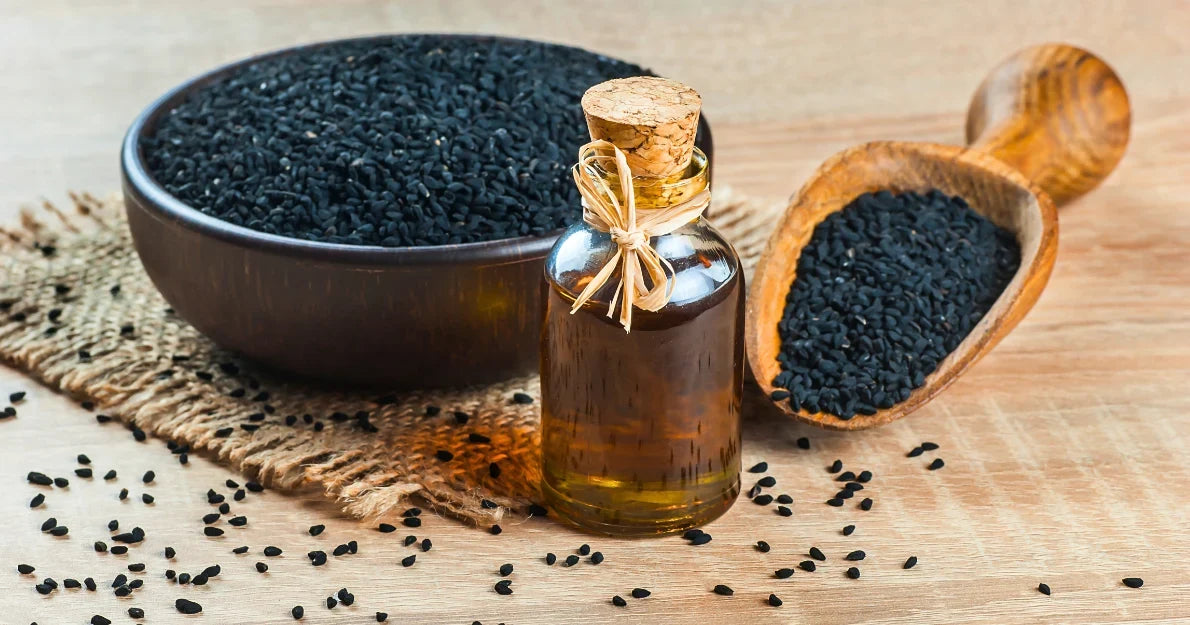
Black seed oil has been prized for more than 2,000 years, but modern science is only beginning to explain why this remarkable botanical continues to capture the attention of researchers around the world.1,7
Black seed oil, extracted from the seeds of the Nigella sativa plant, has a long history of use in traditional wellness practices throughout the Middle East, Asia, and parts of Europe.7 Today, it's one of the most extensively studied botanical oils, with research exploring its potential role in supporting immune function, healthy inflammatory balance, metabolic health, and overall wellness. Scientists are particularly interested in thymoquinone, the oil's principal bioactive compound, which appears to play a central role in many of its biological activities. While research continues to evolve, the growing body of evidence has helped transform black seed oil from an ancient traditional remedy into a subject of serious modern scientific investigation.1,2,3
- Black seed oil is extracted from the seeds of the Nigella sativa plant.
- It has been used in traditional wellness practices for more than 2,000 years.7
- Its primary bioactive compound, thymoquinone, has been widely studied for its antioxidant and cell-signaling properties.3
- Modern research is investigating black seed oil's potential role in supporting immune health, healthy inflammatory responses, metabolic function, and stress resilience.1,2,4
- High-quality black seed oil supplements are often standardized to provide consistent levels of thymoquinone.8
- Black seed oil is available as a dietary supplement and is also used in selected skin and hair care products.
What Is Black Seed Oil?
Black seed oil is extracted from the tiny black seeds of Nigella sativa, a flowering plant native to Southwest Asia and parts of the Middle East. Although the plant belongs to the buttercup family, its seeds have a distinctive peppery, slightly bitter flavor that has made them a staple in traditional cuisines and wellness practices for thousands of years.7
Historical records suggest that Nigella sativa was valued as both a culinary spice and a medicinal plant by several ancient civilizations. Archaeologists have even reported finding black seeds in the tomb of the Egyptian pharaoh Tutankhamun—a discovery that reflects the plant's cultural importance, though not necessarily its medicinal use.7
What has kept black seed oil relevant, however, isn't simply its long history. Many herbs have been used for centuries and then faded into obscurity. Nigella sativa has experienced something different: a resurgence of scientific interest. Over the past few decades, researchers have published hundreds of laboratory, animal, and human studies exploring the biological activity of its naturally occurring compounds and their potential effects on human health.1,2
At the center of that research is thymoquinone, the principal bioactive compound found in black seed oil. Researchers have identified thymoquinone as the principal bioactive compound in black seed oil, and a growing body of evidence suggests it is responsible for many of the oil's antioxidant and cell-signaling activities.3
Understanding the role of thymoquinone is one of the keys to understanding why black seed oil has become the subject of so much modern scientific investigation—and why the quality and standardization of black seed oil supplements matter more than many people realize.3,8
What Makes Black Seed Oil Unique?
Not all black seed oils are created equal.
Although every bottle may begin with the same plant, the concentration of biologically active compounds can vary considerably depending on factors such as where the plant was grown, when the seeds were harvested, how the oil was extracted, and how the finished product was processed and stored. Those differences can have a meaningful impact on both quality and consistency.1
The compound that receives the greatest scientific attention is thymoquinone (TQ). Naturally present in black seed oil, thymoquinone has been extensively studied for its antioxidant properties and its ability to influence multiple biological pathways involved in immune function, healthy inflammatory balance, cellular health, and metabolic function.3
As interest in black seed oil has grown, researchers have increasingly recognized the importance of standardization. Standardized extracts are manufactured to deliver a consistent amount of thymoquinone from batch to batch, allowing both researchers and consumers to know exactly what they're getting. This consistency is particularly important in clinical research, where standardized ingredients help ensure that study results can be interpreted and reproduced with greater confidence.8
ThymoQuin®
One example is ThymoQuin®, a premium black seed oil ingredient standardized to contain high levels of thymoquinone while minimizing free fatty acids, compounds that may affect stability and quality. ThymoQuin is also the first black seed oil ingredient to achieve a United States Pharmacopeia (USP) quality monograph, an important milestone that reflects rigorous standards for identity, purity, and manufacturing quality.8
While black seed oil has been used traditionally for centuries, today's research increasingly focuses on high-quality, standardized preparations because they provide the consistency needed for meaningful scientific investigation. As you'll see in the next section, many of the studies attracting attention today are investigating these standardized forms rather than generic, uncharacterized black seed oil.2,8
What Does the Research Say About Black Seed Oil?
Black seed oil has been studied for a remarkably wide range of potential health applications. While no single natural compound is a cure-all, the breadth of research surrounding Nigella sativa is one reason it continues to attract the attention of scientists around the world. Most of the published research has focused on four broad areas: immune health, healthy inflammatory balance, metabolic health, and protection against oxidative stress.1,2
Supporting Immune Health
A healthy immune system depends on balance. An immune response that is too weak may leave the body vulnerable to infection, while one that is overactive can contribute to unnecessary inflammation and tissue damage. Rather than simply "boosting" immunity—a term that's often oversimplified—researchers are increasingly interested in compounds that help support a healthy, well-regulated immune response.
Laboratory and human studies suggest that black seed oil and its primary bioactive compound, thymoquinone, may help support normal immune function by influencing multiple cell-signaling pathways involved in the body's natural defense systems. While more research is needed, these findings help explain why Nigella sativa has remained an important subject of scientific investigation.1,2,3
Maintaining a Healthy Inflammatory Balance
Inflammation isn't the enemy. In fact, it's one of the body's most important protective mechanisms. The real goal isn't to eliminate inflammation—it's to maintain a healthy inflammatory balance, allowing the body to respond appropriately when needed while returning to normal afterward.
This is another area where thymoquinone has attracted considerable research interest. Studies suggest it may influence several of the molecular pathways involved in the body's normal inflammatory response while also supporting the body's own antioxidant defense systems. Together, these actions may help explain many of the health-supporting properties observed in both laboratory and human studies.1,3
Metabolic Health and Healthy Aging
Some of the most exciting recent research has explored black seed oil's potential role in supporting metabolic health. Human clinical studies have investigated its effects on markers such as blood glucose regulation, insulin sensitivity, blood lipids, and other measures of cardiometabolic health. Although results vary among studies, several systematic reviews suggest that standardized black seed oil supplementation may provide meaningful support as part of an overall healthy lifestyle.2,5
Researchers have also begun investigating black seed oil's effects on physical and mental resilience during periods of stress. In one human clinical trial, a standardized black seed oil extract rich in thymoquinone was associated with healthy cortisol levels and other markers related to recovery following prolonged physical exertion. These findings have generated growing interest in black seed oil's potential role in supporting resilience, recovery, and overall well-being.4
How Is Black Seed Oil Used Today?
Although black seed oil has a long history of traditional use, today's consumers are using it for a variety of modern wellness goals. Some people take it as part of a daily routine to support overall health, while others are interested in its potential role in maintaining immune function, promoting metabolic health, or supporting healthy aging.1,2
The most common way to use black seed oil is as a dietary supplement. It is available in liquid form as well as softgel capsules, making it easy to incorporate into a daily wellness routine. Because the oil has a naturally strong, peppery flavor, many people prefer capsules, while others enjoy adding small amounts of the oil to foods such as salad dressings or dips. Black seed oil is generally not used as a cooking oil because high heat may affect some of its naturally occurring compounds.1
Black seed oil is also found in a variety of skin and hair care products. Traditionally, it has been used to moisturize dry skin and improve the appearance of hair, and modern cosmetic formulations continue to include black seed oil because of its naturally occurring fatty acids and antioxidant compounds. While research in these areas is still developing, its long history of traditional use has made it a popular botanical ingredient in personal care products.1,7
Choosing a High-Quality Black Seed Oil Supplement
As black seed oil has become more popular, the number of products on the market has grown dramatically. Unfortunately, quality can vary just as dramatically.
One of the most important considerations is standardization. Because thymoquinone is the compound most closely associated with black seed oil's biological activity, choosing a supplement that provides a consistent, standardized amount of thymoquinone can help ensure greater quality and reliability.3,8
It's also worth paying attention to manufacturing quality. Reputable manufacturers use carefully controlled extraction methods, test for purity and identity, and follow recognized quality standards to help ensure that every batch meets the specifications listed on the label.8
Consumers should also remember that dietary supplements are intended to support health—not replace a healthy lifestyle or appropriate medical care. A nutritious diet, regular physical activity, quality sleep, and stress management remain the foundation of long-term wellness. Black seed oil may be a valuable addition to that foundation, but it works best as part of an overall healthy lifestyle rather than as a stand-alone solution.
The Bottom Line
Black seed oil has traveled an extraordinary path—from an ancient botanical used in traditional wellness practices to one of the most actively researched plant oils in modern nutritional science.1,7
While researchers continue to explore its full potential, decades of laboratory research, animal studies, and an expanding body of human clinical trials have helped illuminate why this remarkable plant has attracted so much scientific attention.1,2
Much of that interest centers on thymoquinone, the principal bioactive compound found in black seed oil. As our understanding of thymoquinone has grown, so has the appreciation for the importance of product quality, consistency, and standardization. Not all black seed oil supplements are the same, and choosing a high-quality, standardized product can help ensure you're getting the level of quality used in many of today's research studies.3,8
Like many evidence-based dietary supplements, black seed oil is best viewed as one piece of a comprehensive wellness strategy. Combined with a healthy diet, regular exercise, restorative sleep, and other healthy lifestyle habits, it may provide meaningful support for overall health and well-being.1,2
The story of black seed oil is still being written. As new research continues to emerge, this ancient botanical remains an excellent example of how traditional wisdom and modern science can work together to deepen our understanding of natural health.1,2
The information in this article is intended for educational purposes only and should not be considered medical advice. Dietary supplements are not intended to diagnose, treat, cure, or prevent any disease. Always consult a qualified healthcare professional before beginning any new dietary supplement, especially if you are pregnant, nursing, taking medications, or have a medical condition.
